Biography
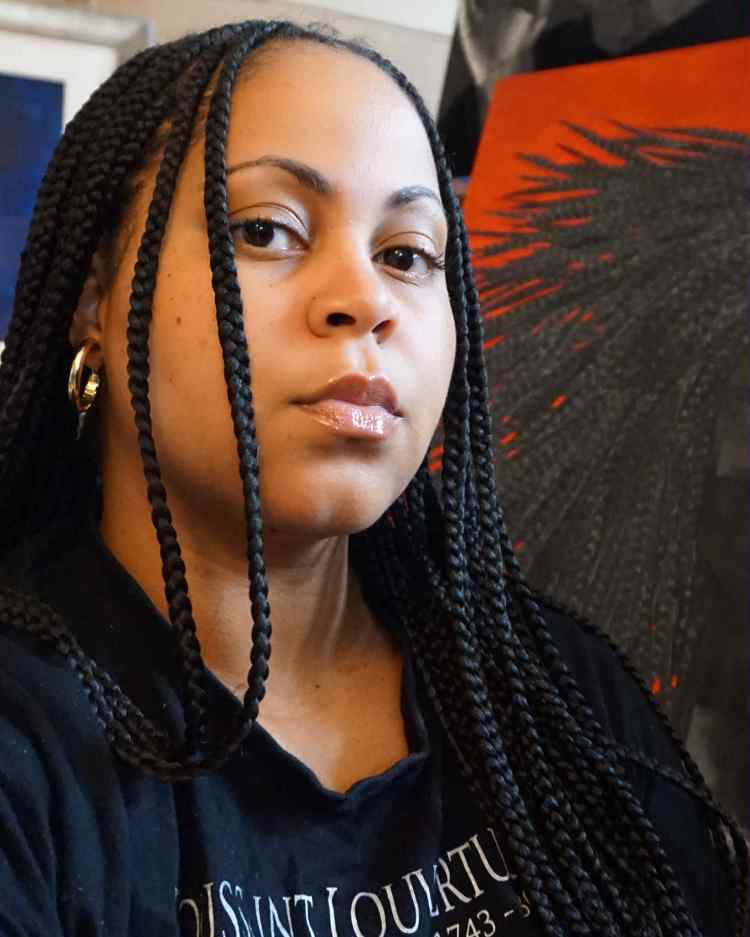
Paula Mans is a Washington, DC-based mixed media artist and art educator. While Mans is a native Washingtonian, she spent many of her formative years living in Tanzania, Mozambique, Eswatini, and Brazil. Her experiences throughout Africa and its diaspora shaped her identity and informed the development of her artistic voice. Mans’ work has been acquired by the DC Commission on the Arts and Humanities Art Bank and featured in institutions such as the American University Museum at the Katzen Arts Center, the New Bedford Art Museum, and IA&A at Hillyer. Mans is a Sustainable Arts Foundation grantee, a recipient of the DC Commission on the Arts and Humanities Fellowship, a Vermont Studio Center Visual Art Fellow, and a Fulbright Research awardee.
Artist Statement
I view collage as emblematic of the interconnectedness of the African Diaspora. Just as the dispersed people of the Diaspora are tied together by the common thread of ancestry, in collage, disjointed pieces are fused to communicate one story. The Transatlantic slave trade forcibly displaced millions of West Africans. These Africans were thrown into the bellies of ships alongside fellow enslaved people with whom they did not necessarily share a common language, ethnicity, or religion. Rather than perish, enslaved Africans chose to survive – taking remnants of their identities and molding them together to form new cultures and identities in the Americas. In my practice, I use collage as a tool that mirrors these historical processes. Drawing from imagery of people from across the African Diaspora, I deconstruct, bond, and resignify small parts to assemble new faces and forms that communicate cultural memory. I create works that are visual records of Black protagonism – utilizing the “Black Gaze” as a deliberate tool to amplify the agency of my figuration. Rather than subjects to be viewed and consumed, I construct figures that look defiantly out onto the world – imbued with the power to engage and challenge the viewer.
In my ongoing body of work, Cotton Flower, I employ an afrofuturist and ecowomanist framework to re-imagine the relationship between enslaved women and the land. In slave societies, power was constructed not only through race but also through gender. Enslaved women were exploited for their labor and capacity to sustain the workforce through childbirth. On cotton plantations, some enslaved women engaged in gendered acts of resistance, by ingesting the roots of cotton plants to prevent pregnancies and induce abortions. Establishing a parallel between the state-sanctioned reproductive violence committed against enslaved women and the instrumentalization of nature for resource extraction by colonial systems, Cotton Flower utilizes speculative storytelling to imagine solidarity and symbiosis between enslaved women and the earth. The works in this series document the supernatural metamorphosis of the enslaved woman’s body as she ingests the cotton plant. By consuming the plant, she regains full control of her body, heals her spirit, and merges with the natural world that envelops, strengthens, and protects her. The enslaved woman physically becomes one with the land – her body sprouting the branches and blooms of the cotton plant and unfurling roots that stretch down into the depths of the earth. Through this metamorphosis, both the enslaved woman and the land transform – becoming a unified force that cannot be rooted out by the violence of slavery nor diminished by the commodification of capitalism.
 Paula Mans